


The scale of what is coming
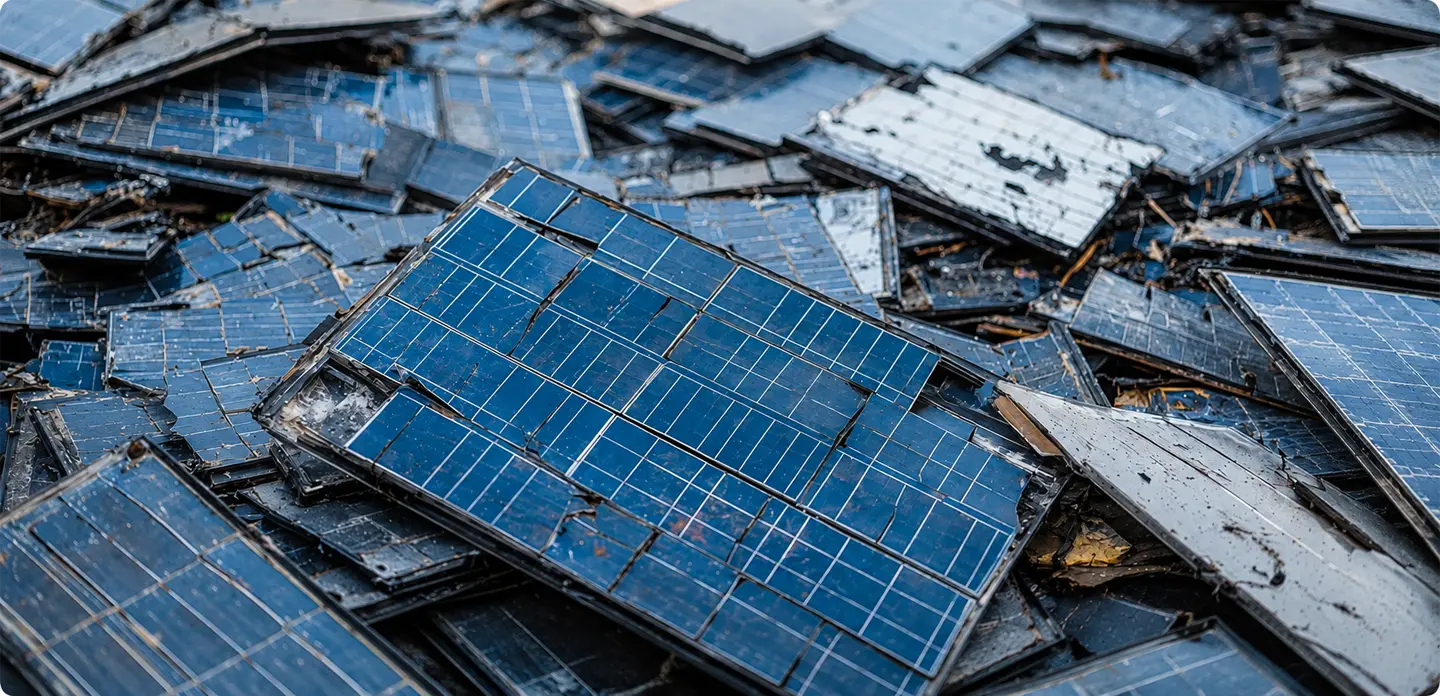
Solar panels have a typical operational lifespan of 25 to 30 years. At least that is the standard performance warranty issued by panel manufacturers. However, drops inefficiency, technological improvements, or financial incentives often put early replacement at around 12-15 years. The first wave of utility-scale installations among the early solar adopters, such as the United States and Germany, came online between 2010 and 2015. That places the leading edge of the end-of-life surge within the next few years.
Globally, IRENA projects that solar panel waste will reach 4 million tons by 2030, rising to nearly 50 million tons by 2040 and more than 78 million tons by 2050 under minimal early-loss scenarios. The catch is that this modelling doesn’t include early replacement. An alternative model created by Harvard Business Review, which incorporates real USA data on early replacement, paints a completely different picture. According to the HBR model, the 78 million tons figure could be reached as early as 2033. The HBR model is in line with our experience on the ground, as we see a growing number of early replacement cases in our work. As the US market accounts for around 10% of global solar installations, that means we are looking at close to 8 million tons in just the US alone.
These numbers are not speculative. They are the direct consequence of the installation decisions already made. Every panel currently generating electricity is a future decommissioning liability. The question is whether that liability is planned for or discovered last minute.
What recycling currently looks like
The honest answer to the question 'what happens to a decommissioned solar panel in the United States today?' is: usually, it goes to a landfill.
The dominant recycling method in current use is mechanical processing — aluminum frames are removed, glass is crushed and downcycled into low-grade construction fill, and the remaining cell stack is shredded and discarded. This approach recovers, at best, the bulk glass and aluminum fraction. It leaves behind the silicon wafers, silver contacts, copper conductors and encapsulant materials that together represent the majority of the panel's recoverable critical materials.
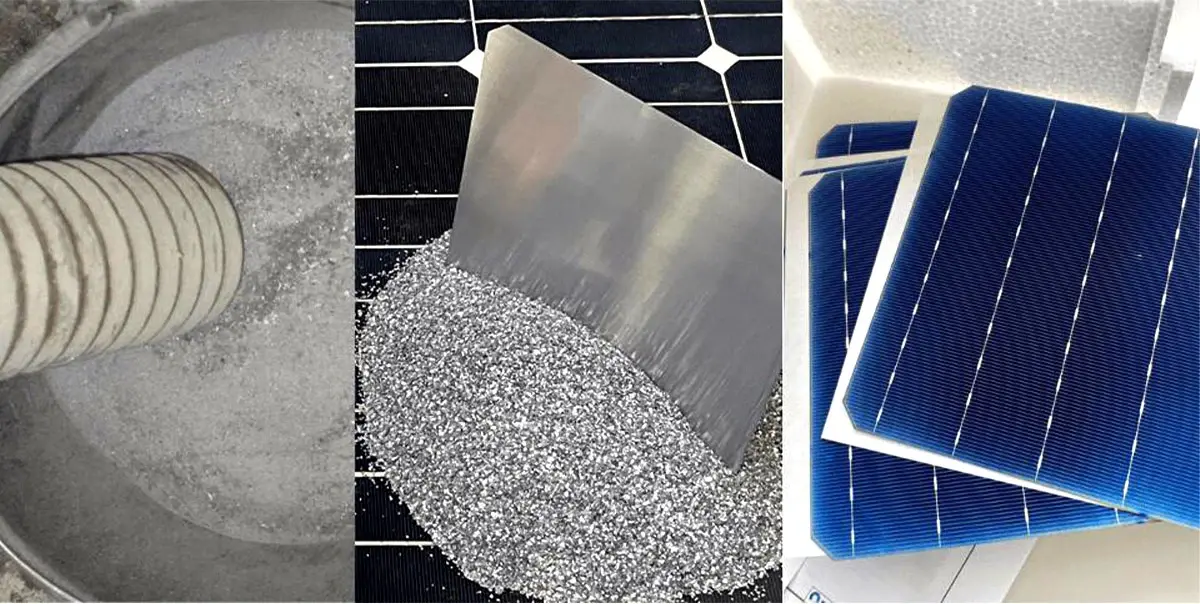
Silver alone is the most economically significant recoverable material in a crystalline silicon panel, comprising roughly 0.05%-0.1% of panel mass but commanding significant market value. The solar industry already generates 17% of global annual silver demand, and with ever-growing capacity, that number is only going to grow. Recovering that silver at the end of life is becoming not only a sustainability imperative but also a real material supply chain necessity that could otherwise stunt renewable solar adoption.
Advanced recycling processes — including hydrometallurgical and thermo-mechanical methods — are capable of recovering silicon, silver, copper, and high-purity glass, but the costs of such processing remain prohibitive in most cases. There are a few innovative companies globally that are aiming to change the game through innovation. For example, our own subsidiary Refusion uses a combination of mechanical dismantling and multi-stage pyrolysis to eliminate EVA without damaging silicon and silver. But these technologies remain far from mainstream deployment in the United States, where no federal recycling mandate exists, and the cost differential between landfilling ($1–$2 per panel) and advanced recycling ($15–$30 per panel) has, until recently, created a strong economic incentive for the wrong outcome.
The regulatory picture — and why it is moving faster than most portfolios expect
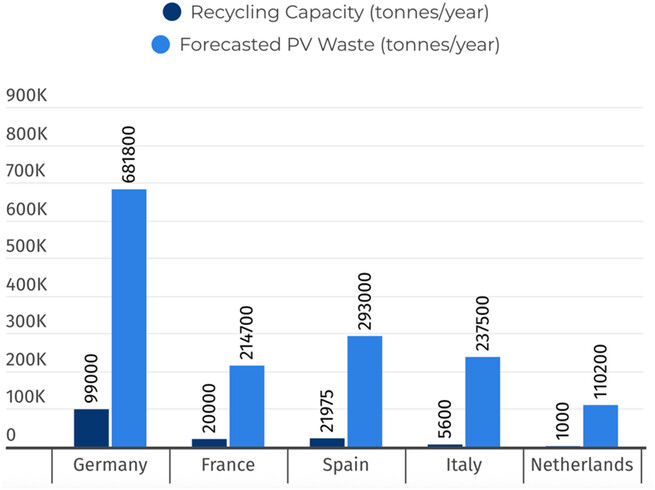
The European Union has had solar panel recycling mandated under its WEEE (Waste Electrical and Electronic Equipment) Directive since 2012. All producers supplying the EU market — regardless of where they are based — must finance the collection and recycling of end-of-life panels. The EU currently has approximately 20 commercial PV recycling plants, with a combined 2026 capacity of around 170,000 tons — already substantially below current EU waste volumes and clearly insufficient for what is coming.
In the United States, the regulatory picture is fragmented but accelerating. The EPA announced a rulemaking effort in October 2023 aimed at adding solar panels to universal waste regulations — a significant step toward a more structured federal framework. In the meantime, California, Hawaii, New Jersey, North Carolina, and most recently, Texas – have all enacted state-level end-of-life regulations. Multiple other states have active legislation in progress.
The direction is clear, even if the timeline is uncertain. Asset owners who wait for regulatory clarity before building an end-of-life strategy are making a bet that the planning lead time will be shorter than the legislative runway. Given typical decommissioning project complexity — permitting, logistics, contractor procurement, recycler selection — that is a high-risk assumption.
What makes this an asset management problem, not just an operational one
End-of-life liability is beginning to migrate from operational consideration to balance sheet reality. Several dynamics are accelerating this shift:
- Lender and acquirer scrutiny. Institutions financing or acquiring solar assets are increasingly requesting documentation of end-of-life plans as part of due diligence. The absence of a credible recycling and decommissioning pathway is beginning to affect deal terms.
- ESG reporting requirements. As sustainability disclosure frameworks tighten — including the SEC's climate disclosure rules and voluntary frameworks such as TCFD — the inability to account for end-of-life scope becomes a reporting gap.
- Fund-level liability exposure. Asset manager operating solar portfolios across multiple states face a patchwork of existing and emerging regulations. Non-compliance with state-level disposal requirements can generate material liability.
- IRR impact of inaction. Panels that degrade beyond economic viability without a repowering or recycling plan do not quietly retire. They become stranded assets — generating diminishing revenue against fixed operating costs while accruing decommissioning obligations.
None of these dynamics are future-dated. They are already shaping deal terms and reporting frameworks.
What a credible end-of-life strategy involves
There is a common misconception that end-of-life planning begins at decommissioning. In practice, the decisions that determine whether a decommissioning project is executed efficiently are made 5 to 7 years before the panels come offline.
A credible strategy requires four components:
- Lifecycle data: Accurate performance monitoring that tracks degradation rates at the asset level — not the assumed manufacturer curve. This allows asset managers to identify when repowering or recycling becomes the optimal capital decision.
- Partner qualification: Recycling infrastructure in the US is nascent. Pre-qualifying compliant recycling partners and establishing contractual pathways before demand peaks is both commercially sensible and increasingly necessary, as capacity constraints will favor those with established relationships.
- Regulatory mapping: Understanding which state and federal requirements apply to specific assets, and tracking the legislative pipeline, is an ongoing operational requirement — not a one-time assessment.
- Integrated decommissioning planning: Decommissioning a large solar facility involves permitting, logistics, racking removal, and waste classification in addition to panel recycling. Single-service providers rarely cover this in full. Integrated lifecycle partners who can manage supply for repowering and certified recycling for decommissioning under a single commercial structure can reduce execution risk substantially.
The window to act is open now
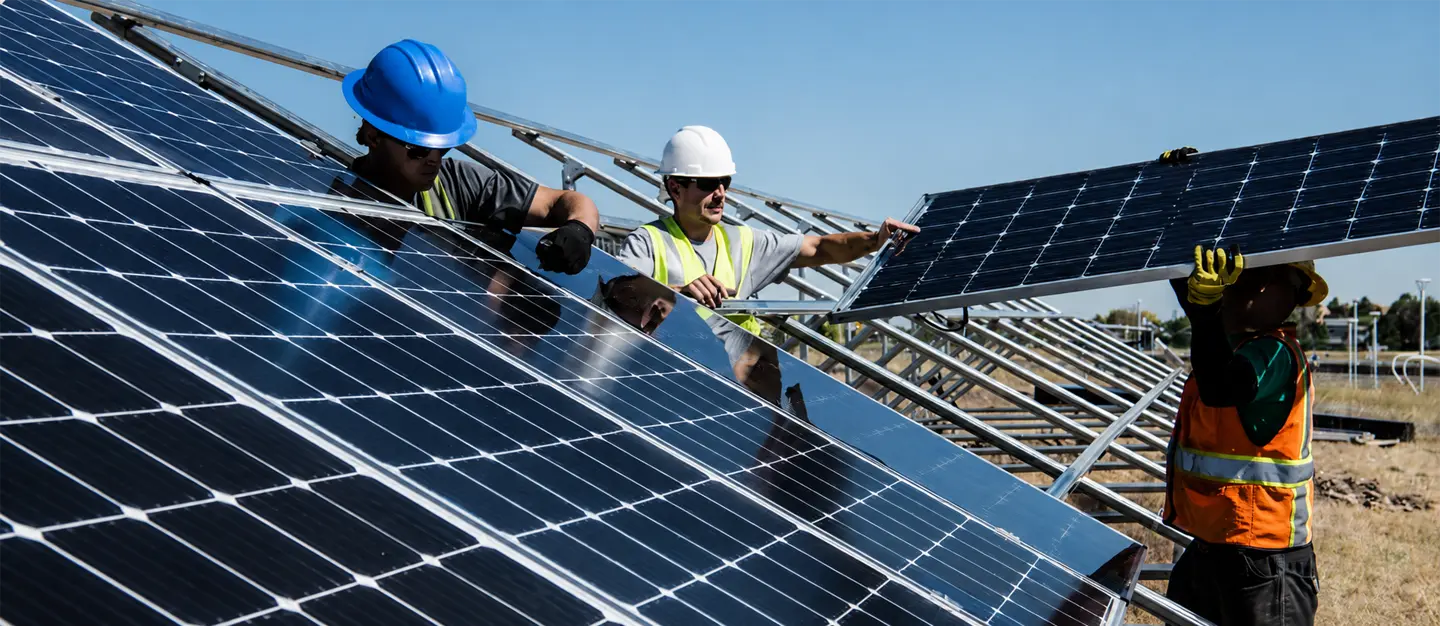
The assets that will generate the largest end-of-life volumes in the 2030s are already in their fifth, seventh, or tenth year of operation. The decommissioning wave is already in motion and will soon shift from modest to critical mass.
The decisions that shape whether that transition is orderly or expensive are not made at decommissioning. They are made years before and depend on the partner relationships, the performance data, and regulatory exposure mapped at present day. Asset owners who treat end-of-life as a future operational question are getting behind the planning curve.
The recycling infrastructure that exists today is insufficient for the volumes coming. It will not scale fast enough to meet unconstrained demand. That creates a straightforward commercial reality: capacity will favor those with established relationships, and urgency will be priced accordingly.
The solar industry has spent two decades building the infrastructure for energy generation. The infrastructure for what comes after has barely started. For asset owners, that gap is not someone else's problem to solve — it is a liability already sitting in the portfolio, accruing value or cost depending on when the planning starts.

.svg)