Our integrated repowering solution turns aging asset liabilities into an opportunity for increasing ROI yields at a fraction of new installation costs.
The first generation of utility-scale solar is reaching an inflection point. Plants commissioned before 2015 were built with modules around 15–16% efficiency, at installed costs two to three times today's. They now carry a decade or more of accumulated degradation, inverters are entering their failure window, and costs of corrective maintenance add up each year.
This puts asset owners in front of a difficult choice: keep operating a declining asset and watch returns erode. Develop something new and join an interconnection queue measured in years. Or rebuild completely and discard racking, piles, wiring, substation, and land rights that are still fully serviceable.
15-40%
Performance loss after 15 years of operation
$500K-2M
Lost in annual revenue per 10MW from degradation
Our Solution
Existing Infrastructure. New Modules. Recovered output.
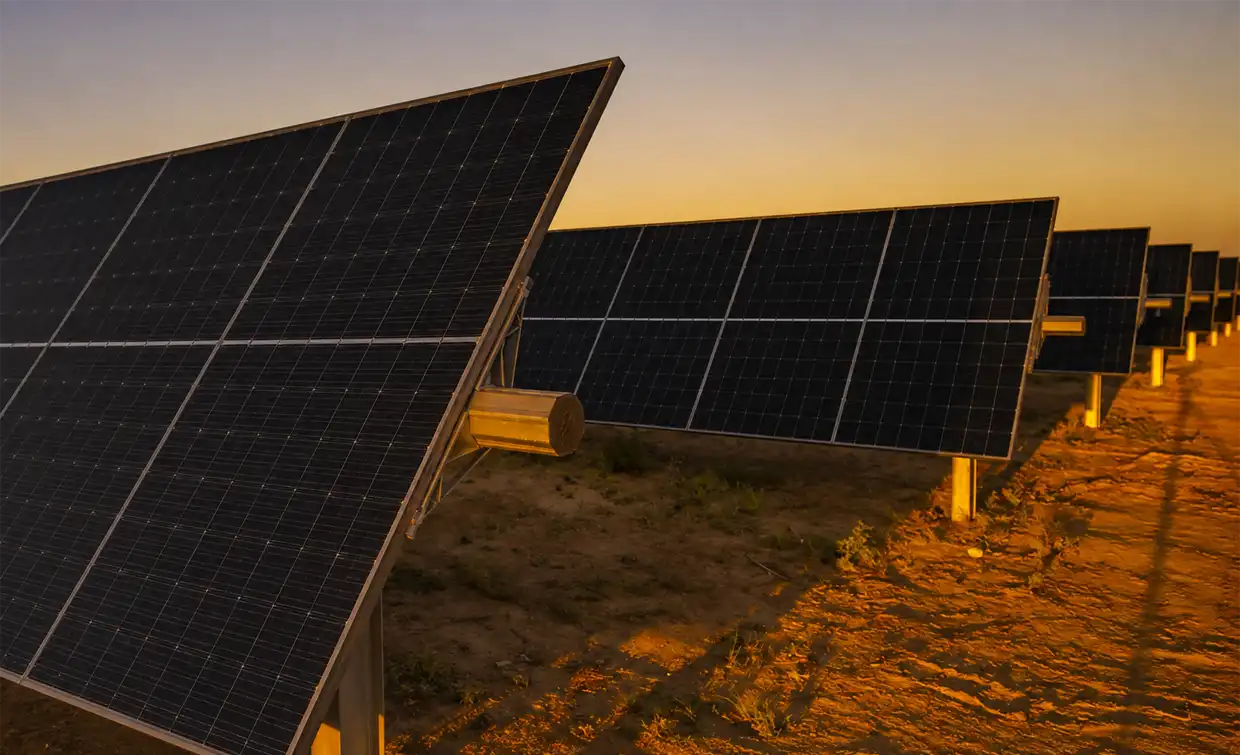
We repower underperforming assets by installing new custom-designed modules onto your existing racking and mounting system. The modules are built to your original frame and clamp dimensions but use current cell technology, reaching 21–22% efficiency while minimizing the costs of a full system rebuild.
30-50%
First year generation increase
Against assets' current degraded output
25-30%
Lower cost compared to full replacement
$0.58/W-DC vs $0.84/W-DC on the reference asset
56%
More lifetime generation
2.88 milion MWh as-is against 4.50 milion MWh on the reference asset
30-50%
First year generation increase
Against assets' current degraded output
25-30%
Lower cost compared to full replacement
$0.58/W-DC vs $0.84/W-DC on the reference asset
56%
More lifetime generation
2.88 milion MWh as-is against 4.50 milion MWh on the reference asset
Case Study
Comparing Annual Output: Legacy vs Repowered System
Integrating capabilities in project development, equipment manufacturing, and end-of-life recovery, we are able to provide our clients with a one-stop-shop repowering solution that eliminates the friction of managing multiple vendors and partners - saving time and money as well as simplifying an otherwise complex and lengthy process.
System Design
We carefully evaluate your project to identify areas of underperformance. Then we develop a new system design with critical upgrades that exceed the original generation capacity of your project.
Working with our exclusive manufacturing partners, we produce new solar modules that match your existing framing and mounting system, but have the same efficiency as top-of-the-line new generation modules.
Your old panels are carefully removed and sent to our subsidiary Refusion Recycling. Panels that retain over 80% of efficiency are refurbished and reused, while the rest is recycled, recovering over 95% of original materials.
We carefully evaluate your project to identify areas of underperformance. Then we develop a new system design with critical upgrades that exceed the original generation capacity of your project.
Working with our exclusive manufacturing partners, we produce new solar modules that match your existing framing and mounting system, but have the same efficiency as top-of-the-line new generation modules.
Your old panels are carefully removed and sent to our subsidiary Refusion Recycling, where they are measured for performance. Panels that retain over 80% of efficiency can be refurbished and reused, while the rest is recycled, recovering over 95% of original materials.
Got Other Questions That You Need Answering? Contact Our Team for Inquiries
Is my asset a good candidate for repowering?
Any solar asset that has been operational for 10 or more years is worth evaluating for repowering. For assets past the 15-year mark, the cumulative financial drag of continued as-is operation generally outweighs the cost of a structured upgrade. Age is not the only factor - the conditions of existing racking infrastructure and remaining lease terms are equally important. The most efficient way to determine fit is through a project assessment. We can structure one quickly with minimal information from your side.
What happens to existing interconnection agreements and permits during a repowering?
Repowering is specifically structured to preserve the existing interconnection agreement — and this is one of its most significant strategic advantages. Because repowering operates within the existing site footprint and replaces components without materially altering the point of interconnection or exceeding permitted capacity thresholds, it typically does not trigger the full interconnection review process required of a new project. For asset owners, this means bypassing the multi-year queue delays that currently constrain new solar development.
Can I expand the power generation capacity of my installation when repowering?
A well-structured repowering program can often accommodate a 10–15% increase in generation capacity without requiring a new interconnection study, depending on the applicable grid operator's rules. This means a repowered asset can exit the process with both a higher output profile and a larger capacity envelope — at a fraction of the timeline and cost of a new build.
What happens with my old panels and how do I stay compliant?
Through our subsidiary, Refusion Recycling, we integrate end-of-life recycling as a solution directly into our repowering service. Refusion does not pass the recycling work to any third-party downstream recyclers to guarantee no modules end up in landfills. It works under strict material tracking protocols and issues sustainable recycling certificates to eliminate any potential risks to asset owners.
Latest Insights
Stay Informed on Solar Industry Trends and Solutions







.svg)
.png)