


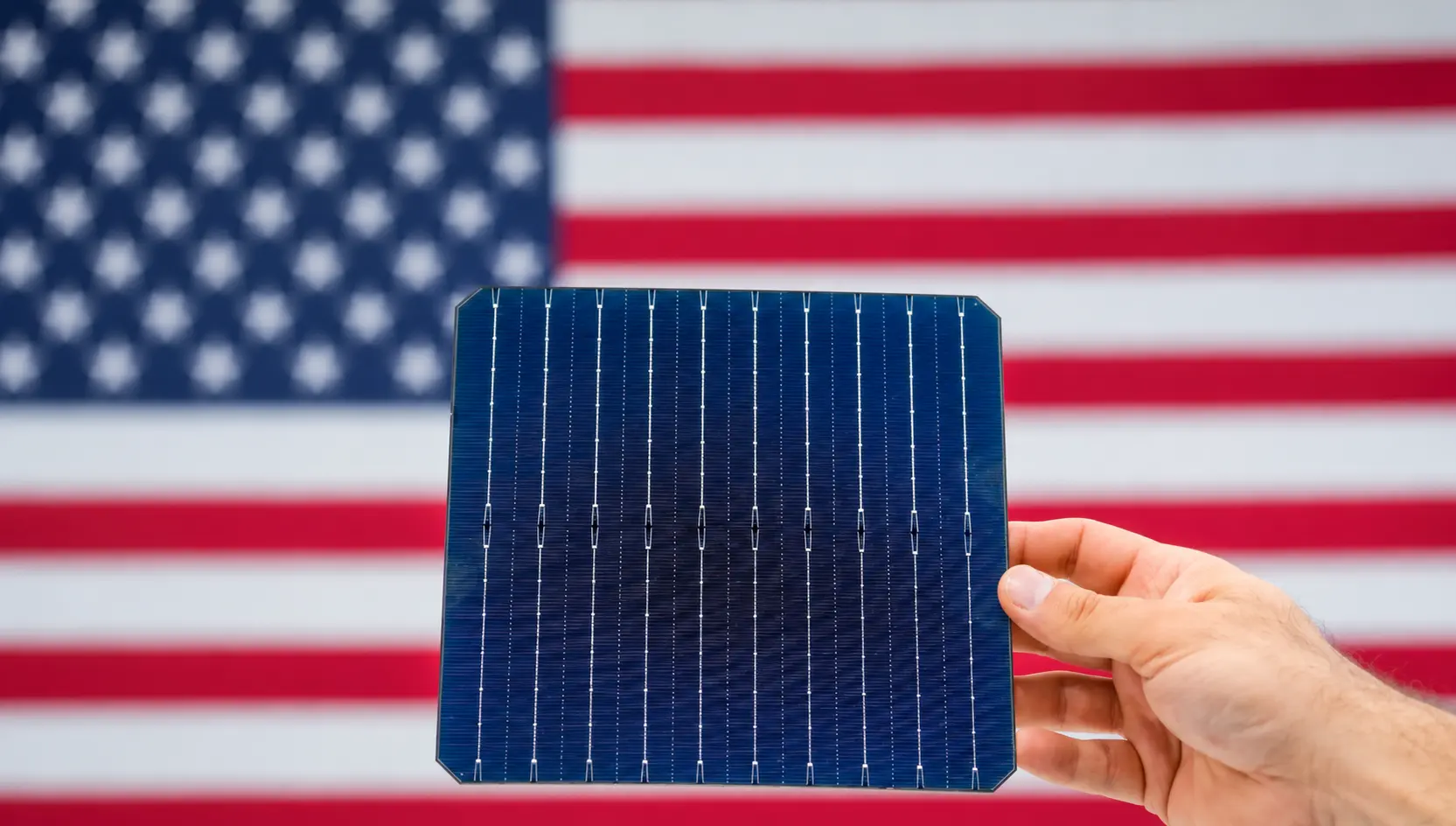
For over two decades, the story of solar manufacturing was that of offshoring. The United States cradled much of the technology, then watched the capacity to build it migrate overseas. By the mid-2020s, the country produced almost none of the polysilicon, wafers, or cells that make up a modern panel. That trajectory has now been sharply reversed. Through a deliberate combination of trade barriers and production subsidies, the US is rebuilding a domestic solar supply chain at a pace few could predict. This piece looks at how that is happening, the momentum already visible, where it may lead over the next five years — and a cautionary lesson the industry would be wise to heed while it still can.
The stick and carrot mechanism
The reshoring push runs on two policy levers working in tandem: one that makes imported products more expensive, and one that makes domestic production more profitable.
The stick is trade policy. In August 2026, a Section 232 national-security proclamation established minimum import prices and tariffs on polysilicon and its derivatives. It sets a floor beneath imported modules, cells, and wafers that takes effect in December 2026 and sits atop existing antidumping and countervailing duties on imports routed through Southeast Asia. The combined effect is to raise the landed cost of foreign-made solar hardware and narrow the price advantage that drove the original offshoring.
The carrot is the Section 45X Advanced Manufacturing Production Credit. It pays domestic producers a fixed amount for every unit they make and sell: 7 cents per watt for modules, 4 cents per watt for cells, $12 per square meter for wafers, and $3 per kilogram for polysilicon — and crucially, those credits stack through the value chain, so a vertically integrated US factory can claim at every stage. The credit survived the One Big Beautiful Bill Act with full value through 2029 and a step-down beginning in 2030, though with new restrictions barring benefits tied to prohibited foreign entities.
Read together, the design is coherent: penalize foreign content, subsidize domestic production, and condition the subsidy on keeping foreign entities of concern out of the supply chain. For the solar industry, the message is clear—build here, source locally, and the future will be bright.
The momentum is already visible
It didn’t take long for this approach to start yielding results. US module manufacturing capacity has grown more than 700% since 2022, surpassing 75 GW by mid-2026, more than enough to meet current annual domestic demand. For the first time, the entire supply chain has a domestic foothold: the first ingot and wafer facilities came online in late 2025, and 45X has triggered more than 50 GW of announced module and cell capacity.
Our team witnessed this momentum firsthand at the inaugural Solar Manufacturing Expo in Austin — one of the largest events dedicated to the US solar manufacturing supply chain, and a clear signal of an accelerating industry. And the conversations on the floor made one thing clear: what's been announced so far is only part of the picture. Considerably more capacity and new manufacturing sites are in development, under validation, and likely to be made public over the coming year.
.webp)
But the same data reveals where the real contest now lies. While module assembly has boomed, the upstream remains thin: the US had only around 10 GW of operational cell capacity in mid-2026 against that 75 GW of module capacity. That gap is the next frontier, and it is filling fast — close to 30 GW of cell capacity, and a growing pipeline of wafer and ingot projects are under construction or announced. The story of the next five years is the migration of reshoring up the value chain: from modules, to cells, to wafers and polysilicon.
.webp)
Where this leads: a view of the next five years
Policy and capital rarely align this tightly, and when they do, the build-out tends to overshoot expectations. A few developments look probable over the next five years, if the current framework holds:
- Vertical integration becomes the winning model.
Because 45X credits stack across polysilicon, wafer, cell, and module, the economics reward companies that own more of the chain. Expect consolidation toward integrated US producers and partnerships that assemble a full domestic supply chain under one banner, rather than standalone module assemblers dependent on imported cells. - The cell and wafer bottleneck closes unevenly.
The upstream gap will narrow as announced capacity comes online, but ingots and wafers are the hardest, most capital-intensive step, and the one where domestic know-how has atrophied most. This is where timelines will slip and where the supply chain stays import-dependent longest. - Demand stays structurally strong.
Solar and storage accounted for the majority of new US generating capacity added in the first half of 2026, and grid-constrained, load-growing markets, such as data centers, are not slowing. The domestic supply chain, unlike in previous solar expansion waves, is being built into a favorable environment of a mature market and rapidly growing demand. - Volume brings a waste stream with it.
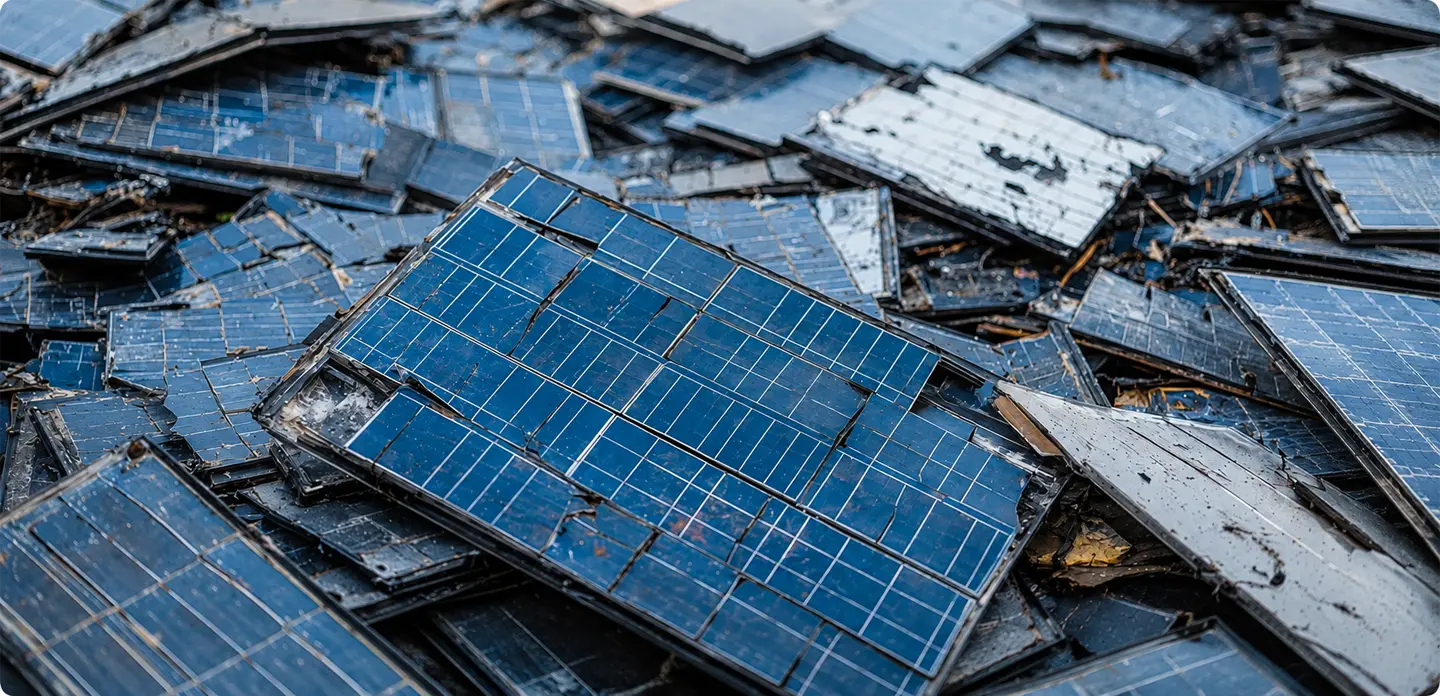
A domestic manufacturing base does not only produce panels. It also means manufacturing scrap, off-spec product, and defective units, at volume, on home soil. More factories mean more production waste generated domestically, adding to the end-of-life volumes already building from the installed fleet. The material has to go somewhere.
A cautionary tale – scale often goes in opposition to quality
There is a hard lesson from every previous solar manufacturing boom, and the US is now positioned to either learn it or repeat it. When manufacturing capacity expands rapidly, especially when upstream components must be sourced locally before the supply chain is mature, quality tends to suffer. It is not hypothetical as independent testing has repeatedly documented it.
Kiwa PI Berlin's 2026 manufacturing-quality report found increasing rates of module failure across the industry, attributing the pattern directly to rapid capacity expansion straining quality control, process stability, and workforce training. The same year, Kiwa PVEL's Module Reliability Scorecard recorded its highest-ever failure rate: 87% of manufacturers logged at least one test failure, up from 66% two years earlier, with light-induced degradation worsening in a pattern the lab linked to the wave of new cell-processing plants coming online.
.webp)
This should not come as a surprise. New factories, newly trained workforces, immature local supply chains, and intense cost pressure combine to let defects through. In our own end-of-life work, we see the downstream consequence of exactly this dynamic in other regions: panels engineered to serve 25 years in the field that are retired after 10, because quality was compromised at the point of manufacture. Quality issues are not visible up front, they appear years later as underperformance, early failures, and an assets written down ahead of schedule.
The stakes for the US are larger than any single project. The last two decades of solar earned their credibility on the promise of 25-year, bankable assets. If a reshoring boom floods the market with underperforming domestic product, the damage is not confined to those panels; it risks eroding trust in solar as an energy class, raising the cost of capital, and could ultimately trigger the very contraction in manufacturing the new policies are trying to prevent.
The task, then, is to ramp and hold the line on quality at the same time through independent testing, robust bill-of-materials discipline, and procurement standards that reward reliability over the lowest bid. The buyers have a role here too: demanding tested, verified product is what makes quality commercially rational for manufacturers under cost pressure.
Closing the loop: reshoring should include recovery
There is a version of these reshoring efforts that could be more complete than what we are currently witnessing. Bringing the supply chain home has so far meant polysilicon, wafers, cells, and modules. But for a truly resilient supply chain, especially in an environment of rising demand for critical materials - It also needs to include recycling and material recovery.
First, volume. As established above, a domestic manufacturing base generates its own waste stream on top of the panels now beginning to retire from the installed fleet. That material is accumulating on home soil and needs a domestic route to handle it.
Second, and more compelling: feedstock. The same reshoring logic that justifies subsidizing domestic polysilicon applies to recovering silver, silicon, copper, and glass from end-of-life panels and manufacturing scrap. Recovered materials are, by definition, domestic materials — supply-chain inputs that do not have to be imported, tariffed, or sourced from a foreign entity of concern. A recycling base turns the waste of a reshored industry into feedstock for it, closing a loop the current policy framework has not yet fully recognized. 45X already gestures in this direction, extending credit to critical minerals that are extracted, processed, or recycled in the US. The principle is established; what is missing now is the scale.
The point is simple. Now that the US is bringing the entire supply chain home, it is important that the supply chain includes strong domestic recycling and material recovery. A reshored industry that can build panels but cannot responsibly recover them has only brought home half the chain.
The bottom line
The future of solar manufacturing in the US is, on the current evidence, bright. The capital is being invested, the policy framework is coherent, and the demand is enormous. The reshoring is real and, for the next five years at least, likely to accelerate up the value chain from modules toward cells, wafers, and polysilicon. The two things that will determine whether it lasts are not in doubt as goals, only as execution: that the industry scales without sacrificing the quality that makes solar a bankable 25-year asset, and that it treats recycling and material recovery as part of the supply chain it is rebuilding and not as an afterthought bolted on once the panels start coming back. Build it well, build it whole, and the third wave of solar in US can be more durable than the first two.


.svg)