


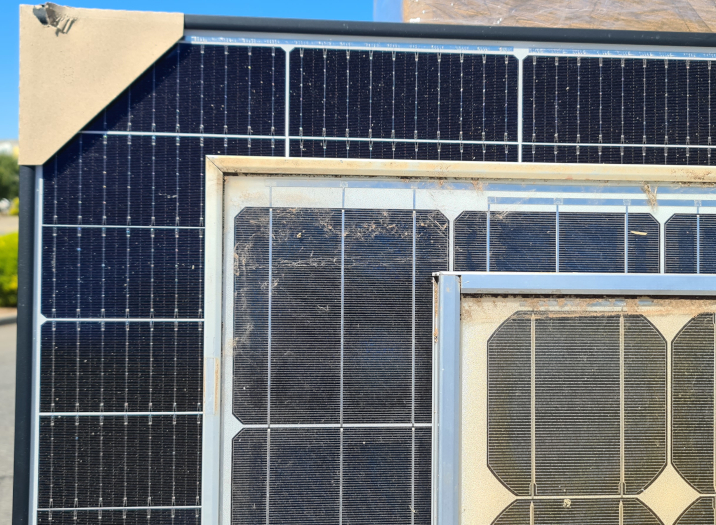
The Secondary Market Illusion
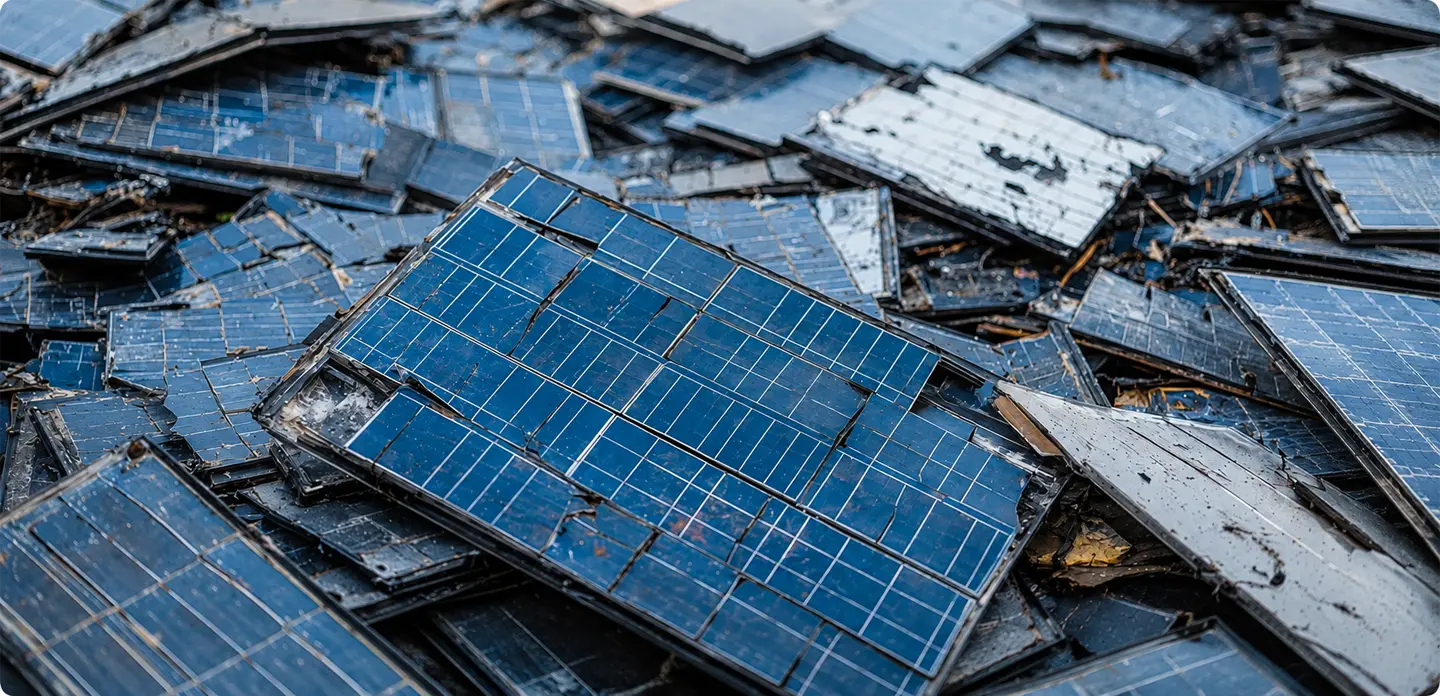
By 2030, early-replacement projections suggest approximately 11.92 million tonnes of solar panels will have reached end of life globally on a cumulative basis — with the annual volume reaching end of life around 2030 on the order of 35 to 40 GW of decommissioned capacity. The global secondary market for used panels currently moves around 1 GW per year.
For resale to absorb that annual volume, it would need to grow 35 to 40 times over. It will not, and the reason is not that the used panels are expensive. Used modules already sell for around $0.07 per watt. The reason is that the panel is the cheapest part of a solar installation, and every other cost stays the same whether the panel is new or second-hand.
The convenient falsehood
A convenient assumption has settled into parts of the solar industry's thinking about end-of-life: that the secondary market will absorb a significant share of decommissioned panels, extending asset life, generating recovery value, and reducing the volume that must be recycled. The assumption is not unreasonable in principle. Secondary markets have historically extended the life of functional equipment, and there is a genuine, if small, market for used solar panels.
The problem is scale and, more fundamentally, economics. The volume of panels approaching the end of life in the 2030s is not a marginal increment on today's secondary market. It is a structural surge that the demand side cannot absorb, for reasons rooted in how panels age, how installations are actually priced, and how the parties who would have to handle used panels make their money.
What the secondary market actually looks like today
The clearest data on the secondary solar market comes from EnergyBin, a B2B wholesale exchange tracking panel resale across more than 1,000 member companies. Its 2025 figures are revealing. Of the 1.62 million modules listed for resale that year, 98% were new panels that entered the secondary channel through project cancellations, delayed installations, or asset liquidations. Genuinely used modules, panels that had been installed and operated, were just 1% of listings, down from 5% in 2024 and 64% below 2022 levels. The average used-module price fell 30% from January 2024 to $0.058 per watt by Q4 2025, recovering to about $0.07 by mid-2026 as new module prices rebounded.
The secondary market is functioning, but it is primarily a clearing channel for surplus new inventory — not an end-of-life pathway for operated panels. And the economics are moving the wrong way: as new TOPCon modules fell to roughly $0.09 per watt FOB China, the case for paying anything meaningful for a used panel weakened further. Even with prices increasing to $0.12 per watt by mid-2026, the price gap between used and new panels is not substantial enough to justify purchase in most scenarios.
Why cheap panels do not make cheap systems
Used panels are genuinely inexpensive — at just over 7 cents per watt, a fraction of the price of new premium modules. On the surface, this looks like the foundation of a thriving resale market. The flaw in that reasoning is that the panel is one of the cheapest components of solar installation, and it is becoming cheaper relative to everything else.
In a US residential system priced around $2.75 per watt fully installed, the panel itself accounts for only $0.30 per watt — often a little more than 12% of total system cost. The remaining 88% are inverter, racking, wiring, labor, permitting, interconnection, and margin. Every one of those costs is effectively identical whether the panel being installed is a new TOPCon module or a decade-old used one. Saving $0.23 per watt on the module does nothing to reduce the remaining $2.45-plus per watt of the total system costs.
Worse, a used panel produces less power per unit area, so those fixed costs are spread across fewer watts of delivered output — and the system physically needs more panels, more racking, more wiring, more labor, and more land or roof to reach the same capacity. That pushes the cost per watt of installed capacity up at the system level, not down. The country comparisons later in this article quantify exactly how this plays out.
The EPC problem: the people who install used panels do not want to
There is a further barrier that is rarely discussed but structurally decisive: the installers and EPCs who would have to deploy used panels have no commercial incentive to do so, and several reasons not to.
Most EPCs and installers do not merely install panels — they procure and resell them, earning a margin on the hardware. A used panel sourced by the customer or bought at near-zero cost on the secondary market strips out that margin. The EPC is being asked to do the same labor-intensive installation work for less total revenue.
On top of lost margin, used panels carry an elevated risk that attaches to the installer. Panels with unknown degradation histories, expired warranties, ageing connectors, and potential micro-cracks or backsheet deterioration are more likely to fail or underperform — and in many jurisdictions, liability for system performance and safety traces back to the installer. An EPC putting its name on a system built from second-hand equipment is accepting brand and warranty risk on hardware it cannot stand behind, for less money than installing new panels. Faced with that trade, the rational EPC declines. Even where a willing buyer of used panels exists, the channel that would have to install them is structurally reluctant to participate.
Why the residential market cannot scale to absorb used panels
The optimistic case for secondary market absorption often centers on residential demand, particularly in cost-sensitive markets. Several structural barriers limit how far this can scale:
- Roof space is finite.
A rooftop accommodates a system size set by area and structural load. A lower-wattage used panel means more panels, more mounting hardware, and more labor to reach the same output. And the roof may simply not have the room.
- Buyers size to demand, not to supply.
Households install to match consumption; discounted supply does not create new demand for capacity.
- No transferable warranty.
A 2017 panel decommissioned in 2032 carries no manufacturer warranty — compare that to a new panel that is covered for 25 to 30 years.
- Financing and insurance friction.
Solar loans and many home insurers require panels meeting age and condition standards. Used panels with no warranty and no certified condition history complicate both, and without financing, the accessibility cheap panels promise disappears.
- Technology obsolescence.
A 2017 PERC panel ran 270 to 290W at 18 to 19.5% efficiency. At 85% of its original capacity, it now delivers roughly 230 to 247W. A current TOPCon panel of the same physical size delivers 420 to 430W, and packs far more watts per square meter, roughly 1.4x the usable output from the roof or land plot.
Why C&I and utility-scale demand cannot absorb the volumes either
When we zoom out to a larger scale, the barriers differ but are no less prohibitive:
- Volumes arrive at scale and need single-offtake buyers.
A 50 MW decommissioning needs one counterparty able to take the full volume with a chain-of-custody documentation and liability transfer. The secondary market has few buyers of that type at that scale.
- Cashflow constraints eliminate small players.
Most secondary-market trading runs on net-60 terms, so the distributor must pay the asset owner within 60 days. But large volumes can't go to one buyer — they fragment across many, and carrying the unsold balance until it clears demands more working capital than most players can absorb.
- Distribution multiplies cost and risk.
Spreading a megawatt-scale lot across many buyers means many separate due diligence, logistics, and liability exposures. These additional overheads reduce the margin on near-free panels.
- Warranty is a financing precondition.
Financed projects require bankable manufacturer warranties. Used panels without them are, in mainstream project finance, simply not bankable.
- Technical qualification.
Grid-connected projects require current IEC certification. Older panels may need re-testing at a cost exceeding their value, effectively excluding them from mainstream projects.
New vs. used: three markets, two project scales
To make the economics concrete, the tables below model the same installations built two ways — once with new 420W panels, once with used 2017-vintage panels operating at 85% capacity (238W effective) priced at $0.07 per watt. There is one table per market: Germany, the United States, and Nigeria. Within each, the comparison is shown at two scales: a residential system (8 kW) and a commercial / utility-scale project (50 MW).
In every case, the method is identical: the module cost changes, and every other cost is held at that country’s prevailing market rate. Because the used panel delivers a little over half the output of a new one, the used-panel system needs roughly 1.8 times as many panels — and proportionally more racking, wiring, and labor. Those 2017 panels are also physically smaller than a modern module, so the footprint grows by roughly 1.4x rather than the full panel-count ratio, but it still requires materially more roof or land. The land and roof footprint is included explicitly because this area penalty is one of the highest hidden costs and is routinely omitted from the cheap-panel argument.
IMPORTANT: The cross-country comparison that follows is illustrative, not definitive. Cost data across three markets of this structural diversity cannot be sourced from a single provider or a single year, and the Nigerian figures in particular carry the widest margin of uncertainty — the informal residential solar market there is defined by self-installation, cash transactions, and minimal regulation, which makes any like-for-like comparison against a permitted, financed, grid-connected installation in the US or Germany a structural simplification. The numbers are built to show the shape of the economics and support the argument, not quote a price. Any real market project requires careful planning and independent modeling on a per-case basis.
New panel: 420W TOPCon. Used panel: 2017 280W module at 85% = 238W effective, $0.07/W. Non-module costs held at each country’s prevailing market rate). Figures are directional and illustrative, USD used for comparability.
United States
Highest soft costs of the three; commercial projects still have ITC availability in the short-term (§48E), but the 30% residential credit (§25D) expired at the end of 2025; finance- and warranty-dependent. Average cost of $0.26 per Watt used.
The verdict: with the highest soft costs of the three, the module is barely 12% of a US system. Nearly doubling the panel count adds more racking, wiring, and labor than the cheap module removes, so the residential used system costs more in total and per watt. At 50 MW, the used build’s lower headline cost — about $62.1M against $63.0M — is illusory: the loss of bankability makes any cost savings moot.
Germany
Lowest soft costs in the world, highest grid prices, and typically space-constrained urban roofs.
The verdict: At residential scale, the used system saves only about 1.5%, and that saving is erased the moment the ~1.4x roof area exceeds available space or EEG/Marktstammdatenregister registration stalls on uncertified panels. At 50 MW, the ~$1.5M module saving is overwhelmed by the additional racking, wiring, and labor for the extra ~91,000 panels — the used project costs about $4.1M more in total and lands at $0.83/W against $0.75/W new.
Nigeria
Most favourable case: battery-dominated cost in residential, cash/off-grid market, warranty and financing less critical, space less constrained.
The verdict: Nigeria residential is the one place used genuinely wins. The decisive difference is that installation here is informal — self-installed or fitted by small crews at local wages of around a dollar an hour, with improvised mounting and negligible permitting or margin. An 8 kW install is on the order of 30 person-hours — a crew of three for a day or two — so install labor is perhaps $50–150, not the thousands a formal US or German install carries. With those count-driven costs so low in absolute terms, the cheap module decides the outcome and the residential used system comes in roughly 10% cheaper. At 50 MW, where Nigerian projects revert to formal, financed EPC work, the advantage disappears — the used build runs a few per cent higher and remains hard to finance without bankable warranties. Even at its best, then, used wins only in a small, informal slice of one favorable market.
The pattern across all three markets
Read together, the three tables tell one story from three angles. The US, high soft costs mean the module savings are trivial — the extra panels make the residential used system more expensive outright, and at utility scale the small headline saving is wiped out by the forfeited tax credit. In Germany, the most cost-efficient installation market in the world, the savings are only around 1.5% and are erased by the roof-area requirement and registration friction. In Nigeria residential, where the install is informal — DIY or a local electrician at around a dollar an hour — labor is so low that the cheap module decides the outcome and used comes in roughly 10% cheaper; that is the legitimate niche. But at utility scale, where Nigerian projects revert to formally financed EPC, used loses again, and the niche is far too small to absorb global volumes. Everywhere else, the increase in panel count drives up racking, wiring, labor, and physical footprint. The module doesn’t change the picture materially, as it was never the main carrier of cost.
This is the structural reason the secondary market cannot scale to absorb end-of-life volumes. Not a shortage of buyers willing to take cheap panels, but the fact that cheap panels do not produce a competitive installed system anywhere.
When the used-panel market does make sense
The argument above is not that used panels can’t be brought to a second life – they certainly can. But the secondary market cannot function as the primary end-of-life pathway at scale. There is a genuine, defensible market for used panels — but it exists only where a specific set of conditions is met. Understanding those conditions is useful because they define both where resale legitimately fits and why that niche cannot expand to absorb the coming volumes.
Used panels make economic sense when all of the following are true at once:
- Soft costs and labor are low relative to the module. The lower the non-module share of system cost, the more a cheap panel actually moves the total. This favors markets with low labor costs and simple permitting — the opposite of the US.
- Self-installation and improvised mounting. Where the buyer fits the system themselves or uses informal crews and locally-sourced racking, the costs that scale with panel count nearly vanish — which is precisely what makes the extra panels of a used array affordable.
- Space is not the binding constraint. Where ground area is cheap and plentiful — rural off-grid, large open sites — the ~1.4x footprint penalty of low-wattage panels does not matter. On a constrained urban roof, it is disqualifying.
- The buyer does not need financing or a warranty. Cash buyers in off-grid or self-consumption contexts, who are not relying on a bankable warranty or a solar loan, can absorb the warranty gap that excludes financed projects.
- There is no tax credit or incentive tied to new, certified equipment. Where an investment tax credit (such as the US commercial ITC under §48E) or a feed-in tariff requires new, compliant hardware, using old panels forfeits a benefit far larger than the module saving. (The US residential credit, §25D, expired at the end of 2025.) Used panels fit best where no such incentive exists to lose.
- The panels are in verified good condition with meaningful remaining life. Resale only makes sense for panels with 5+ years of credible operating life left, ideally with documented performance history — not panels already near end of life.
- Volumes are small and local. Resale works for tens or hundreds of panels moving a short distance to a willing buyer — not for the single-offtake, megawatt-scale, chain-of-custody transactions that utility decommissioning produces. Logistics cost rises with distance and erases the price advantage.
These conditions describe real applications: off-grid and mini-grid systems in emerging markets, rural installations on cheap land, small self-consumption projects in low-labor-cost economies, and informal or DIY markets where warranty and financing are irrelevant. In those niches, the used-panel market is legitimate and will continue to exist. But this market can only absorb a fraction of the total incoming volumes, and only for a limited window of time.
The implications for asset owners
The early-replacement scenario (repowering at Y15) projects 11.92 Mt of cumulative solar panel waste globally by 2030. The current secondary market moves about 1 GW per year — roughly 55,000 to 70,000 tons at average panel weights, on the order of 2.5 to 3% of the annual end-of-life volume arriving around 2030: incremental growth in a market that would need transformational growth to function as an end-of-life solution for an exponentially growing waste stream.
There is a further dynamic worth naming. When supply outweighs demand, buyers become picky — and the secondary market is heading into exactly that condition. As volumes surge and new-panel prices keep falling, the buyers who might take used modules can afford to demand documented condition, remaining warranty, and verified performance, leaving the bulk of decommissioned volume with no willing home.
For asset owners, the secondary market should be treated as a narrow pathway for a small subset of assets — panels with 5+ years of remaining life, in documented good condition, in volumes a single buyer can absorb, destined for one of the few markets where the conditions above hold — not as a primary end-of-life solution. For the majority of volumes reaching end of life in the 2030s, the more realistic pathway is certified recycling.
The asset owners building credible strategies are not betting everything on resale. They are qualifying recycling partners, modelling repowering against the economic crossover, and building the contractual frameworks early — before the volumes arrive and the market for compliant end-of-life services tightens.
Sources: EnergyBin PV Module Price Index 2026 · EnergySage & NREL US installed cost benchmarks 2026 · RMI SIMPLE BoS US–Germany soft cost study · BDEW German electricity prices 2026 · Nigeria solar market cost data (BusinessDay, PVPro Nigeria, 2026) · pvXchange module price index 2026 · Pragma Market Research Used Solar Panels Market · IRENA End-of-Life PV projections · Wood Mackenzie Solar LCOE 2025


.svg)